How to Make Bread: Crusty Golden Dutch Oven Boule for Beginners
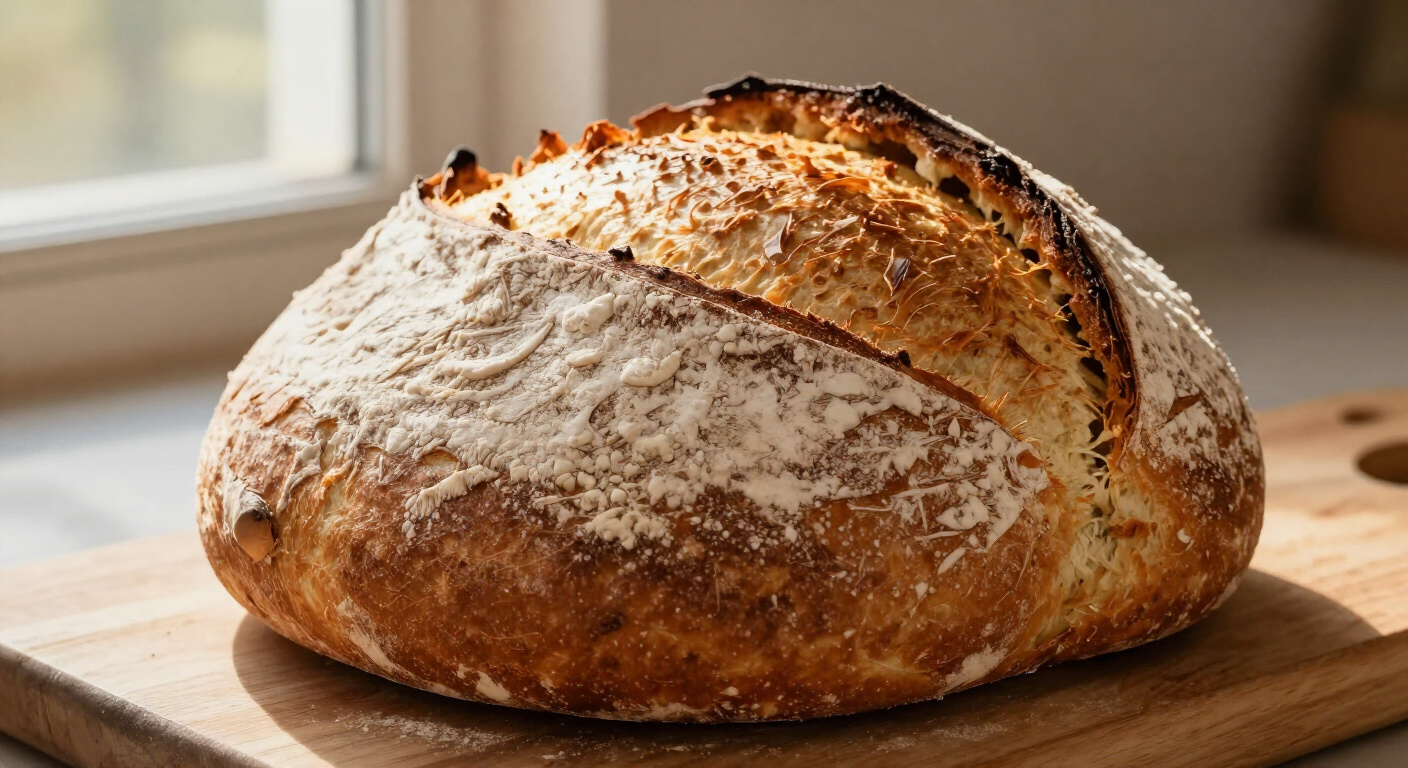
How to make bread at home: just 4 ingredients and a hot Dutch oven give you a crackling golden boule in about 3 hours. Your first loaf starts here.
Learning how to make bread means a crackling, golden-brown boule with a soft, fragrant crumb, ready in three mostly hands-off hours. A hot Dutch oven does the heavy lifting, making your first loaf bakery-worthy and perfect for slow weekend mornings.
Lukewarm 95°F water wakes the instant yeast gently, and ten minutes of kneading builds a springy gluten net. A full hour of cooling lets the crumb set, never gummy.
Ingredients You'll Need
Bread Flour: This is the high-protein flour that gives your boule its chewy, springy crumb and tall rise. That extra protein builds strong gluten, so the dough stretches instead of tearing. Keep a little more nearby for dusting the counter. No bread flour? All-purpose works, but expect a slightly softer, flatter loaf.
Water: Lukewarm water, about 95°F, wakes the yeast gently and turns dry flour into shaggy dough. Too hot and you'll stun the yeast. Too cold and the rise drags on forever. Plain tap water is fine, but filtered water is a good swap if yours tastes strongly of chlorine.
Instant Yeast: These tiny tan granules make the dough puff, bubble, and smell faintly sweet and beery as it rises. Instant yeast mixes straight into the flour, so there's no proofing step to fuss over at dawn. Active dry yeast is the best substitute. Use the same amount and give the rise a little extra time.
Fine Sea Salt: Salt is quiet but essential. It deepens flavor, tightens the gluten, and keeps the yeast from racing ahead. Skip it and your bread tastes flat and bland. Table salt works in a pinch. Use slightly less, since its finer grains pack more saltiness per spoon.


How to Make It (Step by Step)
This whole loaf comes together in one big bowl and one hot Dutch oven: mix, knead, rise, shape, and bake until golden.
Even if your first loaves were bricks like mine, you'll pull a crackling, fragrant boule from the oven.

- Whisk the bread flour, instant yeast, and fine sea salt together in a large bowl until evenly blended with no streaks, about 1 minute at room temperature (70°F / 21°C). This is quiet work. Let your breathing slow down with it.

- Pour in the lukewarm water and stir with a wooden spoon until a shaggy dough forms and no dry flour remains, 1-2 minutes at 95°F / 35°C water temperature. It will look messy. That's exactly right.

- Knead the dough on a lightly floured counter until smooth, elastic, and springy when poked, 8-10 minutes at room temperature (70°F / 21°C). Push, fold, turn. Your hands will find the rhythm.

- Rest the dough in a covered bowl until doubled and puffy, with bubbles pressing at the sides, 1-1½ hours at 75°F / 24°C. Go make coffee. Watch the window turn grey.

- Shape the dough into a tight round boule by tucking the edges underneath until the surface feels taut and smooth, 2-3 minutes at room temperature (70°F / 21°C). Set it on a square of parchment.

- Proof the boule until puffy and a gentle fingertip dent springs back slowly, 30-45 minutes at 75°F / 24°C. Meanwhile, heat your Dutch oven inside the oven at 450°F / 230°C.

- Score the top with a lame or sharp knife in one confident curved slash until the cut opens slightly, about 10 seconds at room temperature (70°F / 21°C). Don't hesitate. Bread forgives you.

- Bake the boule covered in the hot Dutch oven until the loaf has sprung up and set, 20 minutes at 450°F / 230°C. Lower it in carefully by the parchment. Then close that lid and trust the steam.

- Uncover and bake until the crust is deep golden-brown and sounds hollow when tapped, 12-15 minutes at 450°F / 230°C. The inside should read 205°F / 96°C. Your kitchen will smell like heaven.

- Cool the loaf on a wire rack until the crust crackles softly and the bottom feels just warm, at least 1 hour at room temperature (70°F / 21°C). Waiting is hard. Slicing early makes it gummy.

Wrapped in a tea towel, this crackly boule keeps two days and freezes beautifully sliced; revive it in a 375°F oven. Skip the fridge, though. It stales bread fast.
Serving size: 1 portion · Calories: 183 · Total Fat: 0.8g · Saturated Fat: 0.1g · Carbs: 36g · Fiber: 1.3g · Sugar: 0.2g · Protein: 6.3g · Sodium: 465mg
Tips and Tricks
- Equipment: Bake in a heavy lidded Dutch oven: Its thick walls hold fierce, even heat. The lid traps the dough's own steam, so your boule springs tall before the crust sets. Preheat it empty for the full proof, so it's blazing hot when the dough drops in.

- Temperature precision: Trust 205°F, not the clock: Ovens lie, and crusts can brown before the middle is done. Slide an instant-read thermometer into the base of the loaf. At 205°F / 96°C, the crumb is set and tender. Below that, it turns damp and dense.
- Common mistake: Flouring the counter too heavily: Sticky dough tempts you to keep dusting. I did this for months and baked bricks. Every extra handful dries the dough and stiffens the crumb. Use the lightest dusting and let the kneading rhythm smooth out the stickiness.
- Flavour upgrade: Swap in a little whole wheat: Replace about 50 g of the bread flour with whole wheat flour. It adds a nutty, toasty sweetness and a warmer color. Keep everything else the same. The dough just feels a touch thirstier.
- Texture tip: Bake uncovered until it's truly dark: Once the lid comes off, resist pulling the loaf early. Let the crust go deep golden-brown, almost mahogany at the score's edges. That's where the shattering crackle lives. Pale bread softens within an hour.

Frequently Asked Questions
Can I make this bread with whole wheat or all-purpose flour instead?
Swap up to 1½ cups (190 g) of the bread flour for whole wheat flour and add 2 extra tablespoons of water, since bran drinks more. All-purpose flour works cup-for-cup at 500 g, giving a slightly softer, less chewy crumb.
Can I make the dough the night before and bake it in the morning?
Yes: shape the boule, cover it on its parchment, and refrigerate up to 18 hours, then bake cold in the 450°F Dutch oven, adding 3-5 minutes uncovered. A whole baked loaf freezes 3 months double-wrapped; thaw, then re-crisp at 375°F for 10 minutes.
Why did my bread come out dense and flat instead of tall and airy?
Usually the dough was under-kneaded or under-proofed, so knead until a poke springs back and let the boule proof until a fingertip dent fills in slowly, about 30-45 minutes at 75°F. If the dent springs back instantly, give it 10-15 more minutes before scoring.
What to Serve With This
- Creamy Tomato Basil Soup: Its velvety, tangy sweetness begs to be scooped up by that crackling golden-brown crust.
- Lemony Arugula Salad: Peppery leaves and a bright lemon dressing cut through all that warm, chewy crumb.
- Burrata with Blistered Cherry Tomatoes: Cool, milky burrata spread on a crunchy slice is pure, quiet bliss.
- Slow-Simmered Beef Stew: Rich, savory gravy soaks into the soft, airy crumb, so nothing goes to waste.

How to Make Bread: Crusty Golden Dutch Oven Boule for Beginners
Side Dish / American
- Prep
- 20 min
- Cook
- 35 min
- Total
- 55 min
- Servings
- 10
- Calories
- 160 kcal
Ingredients
- 4 cups (500 g) bread flour, spooned and leveled, plus extra for dusting
- 1½ cups plus 1 tablespoon (375 ml) water, lukewarm (about 95°F)
- 2¼ teaspoons (1 packet) instant yeast
- 2 teaspoons fine sea salt
Instructions
- Whisk the bread flour, instant yeast, and fine sea salt together in a large bowl until evenly blended with no streaks, about 1 minute at room temperature (70°F / 21°C). This is quiet work. Let your breathing slow down with it.
- Pour in the lukewarm water and stir with a wooden spoon until a shaggy dough forms and no dry flour remains, 1-2 minutes at 95°F / 35°C water temperature. It will look messy. That's exactly right.
- Knead the dough on a lightly floured counter until smooth, elastic, and springy when poked, 8-10 minutes at room temperature (70°F / 21°C). Push, fold, turn. Your hands will find the rhythm.
- Rest the dough in a covered bowl until doubled and puffy, with bubbles pressing at the sides, 1-1½ hours at 75°F / 24°C. Go make coffee. Watch the window turn grey.
- Shape the dough into a tight round boule by tucking the edges underneath until the surface feels taut and smooth, 2-3 minutes at room temperature (70°F / 21°C). Set it on a square of parchment.
- Proof the boule until puffy and a gentle fingertip dent springs back slowly, 30-45 minutes at 75°F / 24°C. Meanwhile, heat your Dutch oven inside the oven at 450°F / 230°C.
- Score the top with a lame or sharp knife in one confident curved slash until the cut opens slightly, about 10 seconds at room temperature (70°F / 21°C). Don't hesitate. Bread forgives you.
- Bake the boule covered in the hot Dutch oven until the loaf has sprung up and set, 20 minutes at 450°F / 230°C. Lower it in carefully by the parchment. Then close that lid and trust the steam.
- Uncover and bake until the crust is deep golden-brown and sounds hollow when tapped, 12-15 minutes at 450°F / 230°C. The inside should read 205°F / 96°C. Your kitchen will smell like heaven.
- Cool the loaf on a wire rack until the crust crackles softly and the bottom feels just warm, at least 1 hour at room temperature (70°F / 21°C). Waiting is hard. Slicing early makes it gummy.
Share this article
About the author
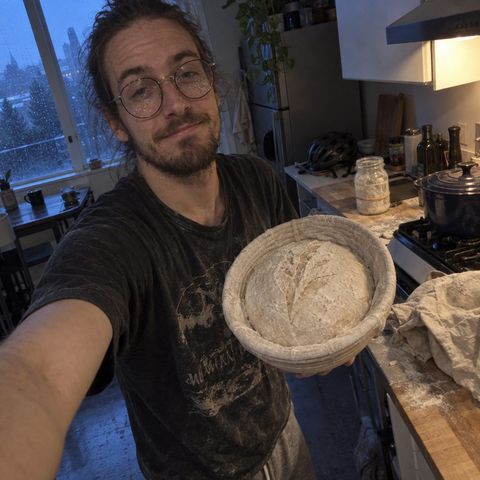
Theo Lindqvist
Theo bakes at five in the morning because anxiety wakes him anyway, and kneading is the one thing that makes his hands stop shaking. His first loaves were bricks and he cried over them. Now he scores a boule in the blue dark and feels, for an hour, completely at peace.