
Rustic Wheat Boule: Is Sourdough Bread Gluten Free?
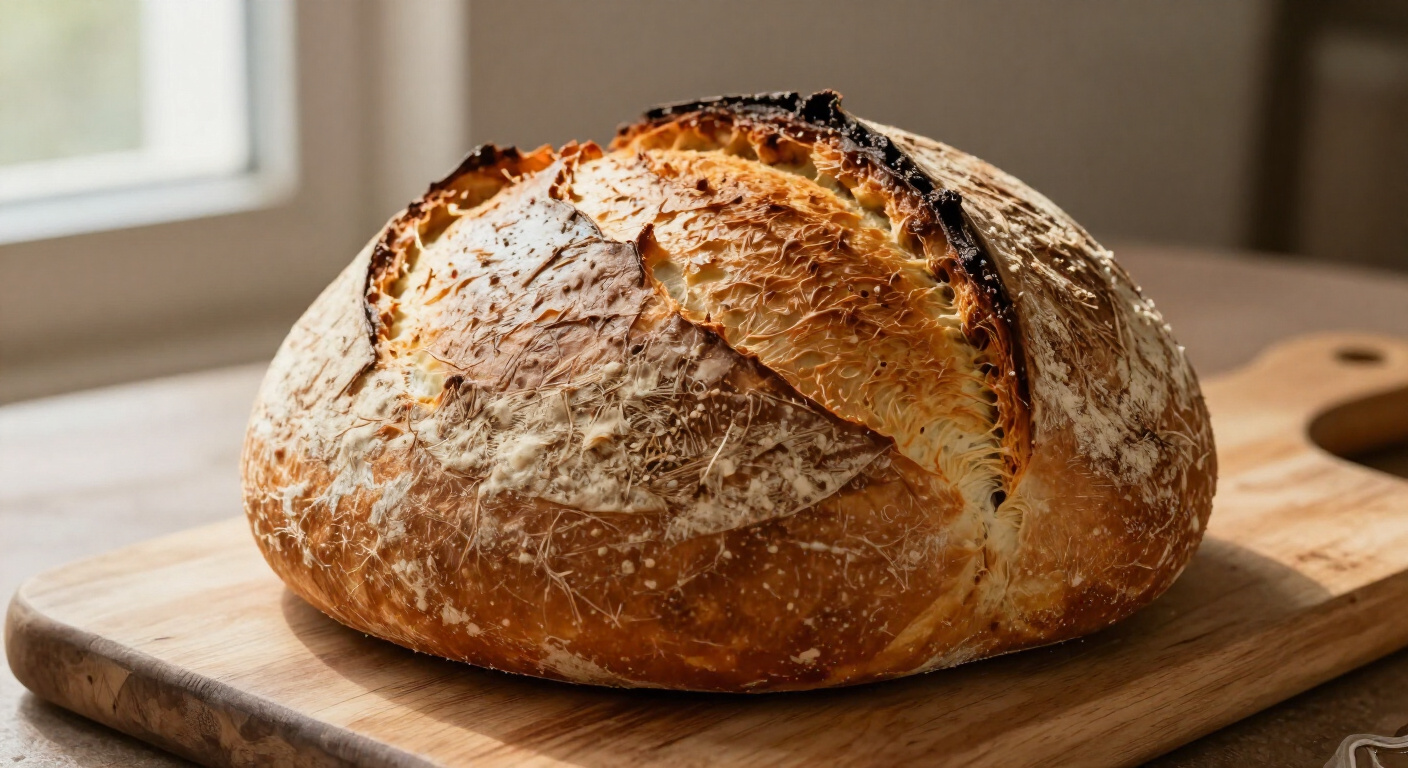
Is sourdough bread gluten free? Not really. Learn what fermentation breaks down in this crackling wheat boule, ready in about seven hours.
Is sourdough bread gluten free? Not close, but one tear reveals a crackling, tangy crumb. Plan seven hours total, with fifteen minutes hands-on, for a golden, hollow-sounding boule. Save it for a slow Saturday when the kitchen smells like toast.
Why This Recipe Works
• Rest before salting the dough: The flour and water rest first, letting gluten strands begin to link. Salt goes in afterward, so the dough feels smooth and springy instead of tearing.
• Stretch and fold every 30 minutes: Each fold slides gluten strands past one another and builds strength without kneading. After about two hours, the dough holds its shape.
• Judge bulk fermentation by sight, not timer: A warm kitchen speeds the rise and a cool one slows it. Watch for half again its size, bubbles at the edges, and a domed top.
• Dutch oven traps steam for lift: A preheated pot with the lid on holds in moisture from the dough. That keeps the surface soft long enough for the loaf to spring fully before the crust sets.
Ingredients You'll Need
Bread flour: This strong white wheat flour gives the loaf its structure, and it's the reason this boule contains gluten. Its high protein builds the stretchy network that traps gas and creates a chewy, open crumb. No flour can replace it and keep the bread gluten free, so the closest swap is all-purpose wheat flour, which gives a softer, less open crumb.
Lukewarm water: Water at about 80°F / 27°C hydrates the flour and wakes up the starter. It also keeps fermentation moving at a steady pace. Filtered water at the same temperature is the best substitute, since chlorine can slow a starter down.
Active sourdough starter: This living culture of wild yeast and bacteria leavens the bread and gives it that tangy flavor. Fed 4 to 6 hours earlier, it's bubbly and ready to lift the dough. You can't skip it and still have sourdough; the closest option is to build your own from flour and water over several days.
Fine sea salt: Salt tightens the gluten network and slows the yeast so the dough doesn't over-rise. It also seasons the bread, so it doesn't taste flat. Table salt works as a substitute, but weigh out the full 10 g, since fine table salt packs denser per teaspoon.


How to Make It (Step by Step)
Starter, flour, water, and salt turn into a shaggy dough that rests, folds, and rises into a boule. Even if your first loaf runs dense, the method is forgiving, and the golden crust rewards every patient hour.

- Whisk the 350 g lukewarm water (80°F / 27°C) and 100 g bubbly active starter in a large bowl until the mixture turns milky and smooth, 30-60 seconds at room temperature (75°F / 24°C).

- Stir the 500 g bread flour into the starter water until no dry flour remains and the dough looks shaggy, 1-2 minutes at room temperature (75°F / 24°C).

- Cover the bowl with a clean tea towel and rest the dough until it looks slightly swollen with a relaxed, smooth surface, 30-60 minutes at room temperature (75°F / 24°C).

- Sprinkle the 10 g fine sea salt over the dough and pinch it in until fully absorbed and the dough feels smooth and springy, 3-5 minutes at room temperature (75°F / 24°C).

- Stretch and fold the dough in its bowl every 30 minutes until it feels elastic and holds its shape, about 2 hours at room temperature (75°F / 24°C).

- Let the covered dough bulk ferment until it rises by about half, with bubbles near the edges and a domed top, 3-4 hours at 75-78°F / 24-26°C.

- Shape the dough into a taut round boule until the surface feels tight and smooth, 1-2 minutes at room temperature (75°F / 24°C).

- Bake the boule in a preheated Dutch oven with the lid on at 475°F / 245°C for 20 minutes, then lid off at 450°F / 230°C for 25-30 minutes until deep golden-brown and hollow-sounding when tapped, 45-50 minutes total.

Recipe Notes
• Storage: Keep the cooled loaf cut-side down in a paper bag or tea towel for up to three days. Skip the fridge, which stales bread quickly. To freeze, slice it first, wrap tightly, and keep up to three months. Toast slices straight from frozen.
• Key substitution: Out of bread flour? Use all-purpose flour and drop the water to 330 g. The crumb turns softer and less chewy, but it still bakes up golden and tangy.
• Make-ahead tip: Shape the boule, place it seam-side up in a floured bowl or banneton, and refrigerate it overnight, up to 12 hours. Bake it straight from the fridge in the same preheated Dutch oven.
• Common mistake: Slicing into the loaf while it's still warm. The inside is still setting, so it turns gummy. Let it cool on a rack for at least two hours first.
Serving size: 1 portion · Calories: 1830 · Total Fat: 8g · Saturated Fat: 1.5g · Carbs: 375g · Fiber: 16g · Sugar: 2g · Protein: 65g · Sodium: 3900mg
Tips and Tricks
- Equipment: Use a heavy lidded Dutch oven: Thick walls hold steady heat around the dough. Pick one large enough that the boule can spring without touching the lid.

- Temperature precision: Drop the heat at minute 20: Start at 475°F / 245°C with the lid on. Then lower to 450°F / 230°C with the lid off. The lower heat lets the crust color deeply without scorching.
- Common mistake: Shaping the boule too loosely: A soft, floppy round spreads flat in the pot. Pull the surface taut until it feels tight and smooth, then bake.
- Flavour upgrade: Add flaky sea salt on top: A light sprinkle just before baking adds a crunchy, savory finish. Use it sparingly, since the dough already has 10 g of fine sea salt.
- Texture tip: Listen for a hollow tap: Deep golden-brown color with a hollow sound means the crust is crisp and the crumb is set. Pale or dull crust needs a few more minutes.

Frequently Asked Questions
Can I make this boule gluten free by swapping the flour?
Not with wheat flour and wheat starter, since fermentation lowers gluten but never removes it. Use 500 g certified gluten-free bread flour blend with 5 g xanthan gum, and build a separate rice-flour starter. Expect a softer, stickier dough that won't hold up to stretch-and-folds.
Can I store and reheat leftover boule without losing its crisp crust?
Wrap the cooled loaf in a tea towel and keep it at room temperature for up to two days, or refrigerate sliced pieces for up to five days. Reheat slices in a 350°F / 175°C oven for about 5 minutes to restore crispness.
Why does my boule spread flat instead of rising tall in the oven?
Dough that's over-proofed or under-shaped usually spreads, so tighten the surface during step 7 until it feels taut and smooth. Look for dough that has risen by about half and springs back slowly when poked, not dough that has collapsed or gone flat.
What to Serve With This
- Whipped Ricotta with Lemon Zest: Cool, airy cream softens the crackling crust and balances every tangy bite.
- Creamy White Bean Dip: Smooth and mellow, it sets off the crisp crust while letting the chewy crumb shine.
- Burrata with Olive Oil: Silky, milky centers spill onto warm slices and soften the loaf's sharp, toasty edge.
- Cucumber and Yogurt Salad: Cool yogurt and crisp cucumber add freshness that cuts through the rich, golden crumb.

Rustic Wheat Boule: Is Sourdough Bread Gluten Free?
Snack / American
- Prep
- 20 min
- Total
- 20 min
- Servings
- 1
Ingredients
- 500 g bread flour (strong white wheat flour), weighed level
- 350 g lukewarm water (about 80°F / 27°C)
- 100 g active sourdough starter, fed 4 to 6 hours earlier and bubbly
- 10 g fine sea salt (about 2 teaspoons)
Instructions
- Whisk the 350 g lukewarm water (80°F / 27°C) and 100 g bubbly active starter in a large bowl until the mixture turns milky and smooth, 30-60 seconds at room temperature (75°F / 24°C).
- Stir the 500 g bread flour into the starter water until no dry flour remains and the dough looks shaggy, 1-2 minutes at room temperature (75°F / 24°C).
- Cover the bowl with a clean tea towel and rest the dough until it looks slightly swollen with a relaxed, smooth surface, 30-60 minutes at room temperature (75°F / 24°C).
- Sprinkle the 10 g fine sea salt over the dough and pinch it in until fully absorbed and the dough feels smooth and springy, 3-5 minutes at room temperature (75°F / 24°C).
- Stretch and fold the dough in its bowl every 30 minutes until it feels elastic and holds its shape, about 2 hours at room temperature (75°F / 24°C).
- Let the covered dough bulk ferment until it rises by about half, with bubbles near the edges and a domed top, 3-4 hours at 75-78°F / 24-26°C.
- Shape the dough into a taut round boule until the surface feels tight and smooth, 1-2 minutes at room temperature (75°F / 24°C).
- Bake the boule in a preheated Dutch oven with the lid on at 475°F / 245°C for 20 minutes, then lid off at 450°F / 230°C for 25-30 minutes until deep golden-brown and hollow-sounding when tapped, 45-50 minutes total.
Share this article
About the author
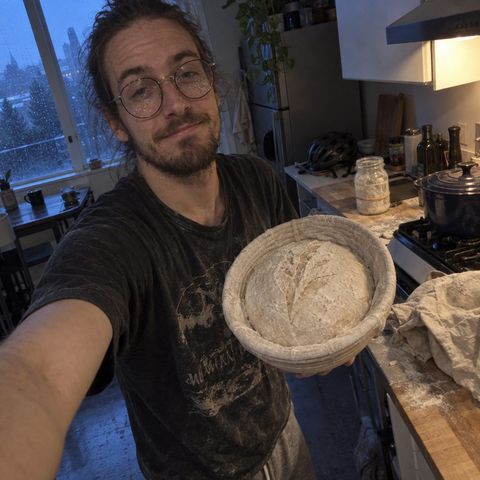
Theo Lindqvist
Theo bakes at five in the morning because anxiety wakes him anyway, and kneading is the one thing that makes his hands stop shaking. His first loaves were bricks and he cried over them. Now he scores a boule in the blue dark and feels, for an hour, completely at peace.